Books guide
How to rank the books you’ve read
Turn a list of finished books into a personal ranking: choose your question, compare across genres, handle series, rereads and unfinished books, and revisit the order.
The short answer
To rank the books you’ve read, decide what the ranking should answer, then compare books two at a time using that question. Treat a series as separate books unless you remember it as one experience, rank a reread by how it feels now, and leave unfinished books out or mark them clearly. Group the result into tiers if a strict order feels too precise.
Choose the question your ranking answers
A reading log records what you read. A ranking says something about it: which books mattered most, and in what order. Before you start, decide what “most” means for you, because different questions produce noticeably different lists.
- “Which has stayed with me longest?” favours books that changed how you think, even if they were hard going.
- “Which would I press into a friend’s hands?” favours books that are generous and easy to love.
- “Which did I enjoy most while reading?” favours momentum and pleasure over reputation.
None of these is the right one. Choose one, write it at the top of your list, and use it for every decision. If you find yourself wanting two lists, make two. It is clearer than a single list that silently switches questions halfway through.
If you have not been keeping track yet, start with how to keep a reading log. A short note about each book will make the comparisons below much easier.
Comparing books across genres
The hardest part of ranking books is comparing things that are trying to do different jobs. Is a tightly plotted science-fiction adventure better or worse than a slim, quiet novella? Asked in the abstract, that question has no answer.
Your chosen question is what makes the comparison possible. “Which has stayed with me longest?” can be answered about any two books, regardless of genre, length or ambition. It shifts the comparison from the books themselves to your experience of them, which is the only thing you are actually qualified to rank.
Two habits help. First, compare two books at a time rather than trying to place a book in a list of thirty. A single pair is much easier to judge. Second, be suspicious of a sense that one genre “ought” to rank higher. If a romance meant more to you than a prize-winner, your ranking should say so. For more on why pairs work so well, see what pairwise ranking is.
Series and rereads
Series. There are two reasonable approaches. You can rank each book separately, which shows that you loved the first Dune novel more than its sequels, for example. Or you can treat the series as a single entry if you remember it as one continuous story. Separate entries give a more honest picture when quality varies; a single entry keeps a long series from crowding your list. Pick one approach for each series and stick with it.
Rereads. A reread is new evidence. A book you loved at sixteen might feel different at thirty, in either direction. Rank the book by how it feels after your most recent reading, and keep your earlier impression in a reading log rather than letting it pull the ranking. If a reread moves a book a long way, that change is itself worth a sentence in your notes.
What about books you didn’t finish?
An unfinished book is a different kind of experience from a finished one, and putting the two in one order can feel unfair to both. Most people get a cleaner ranking by leaving unfinished books out entirely and recording them in their reading log, marked as unfinished, with a word or two about why.
If you do want them represented, keep them in a clearly labelled band at the bottom rather than scattered through the list. That way, when you look back, you can tell “I read this and disliked it” apart from “I stopped on page forty”.
One exception: a book you set aside for reasons that had nothing to do with the book, such as a busy month, is not really a judgement at all. Leave it out until you return to it.
A worked example: six books, one question
Imagine a reader with six finished books, ranking them by the question “Which has stayed with me longest?” This is an illustrative personal preference, not a recommendation list.
They start with pairs that are easy to judge. Pachinko beats Project Hail Mary: the second was more fun to read, but the first is the one they still think about. Piranesi beats The Song of Achilles by a narrow margin. Small Things Like These beats Pride and Prejudice, a surprise to the reader, since the Austen is a reread they love; the Keegan simply comes back to them more often.
Then they compare the winners. Pachinko beats Piranesi. Piranesi and Small Things Like These feel genuinely equal, so they record a draw and decide on a second look later. A few more comparisons among the remaining books settle the lower half.
An illustrative book ranking
“Which has stayed with me longest?”
- Pachinko — Min Jin Lee
- Piranesi — Susanna Clarke (level with 3)
- Small Things Like These — Claire Keegan
- The Song of Achilles — Madeline Miller
- Pride and Prejudice — Jane Austen
- Project Hail Mary — Andy Weir
Asked a different question, “Which did I enjoy most while reading?”, this reader would put Project Hail Mary near the top. Neither order is wrong. Each answers its own question honestly, which is why writing the question down matters.
From an order to tiers
Once you have more than a couple of dozen books, a strict order can start to feel over-precise. Is your thirty-first book really better than your thirty-second? Grouping the order into tiers keeps the useful information and drops the false precision.
A simple approach is to draw lines through your ranking where the gaps feel largest. In the example, the reader might put Pachinko, Piranesi and Small Things Like These in a top band, and the other three in a band below. Within a tier, the order can stay loose. If you want a deeper look at designing tiers, the approach in how to make a movie tier list works just as well for books.
Revisit your ranking
A book ranking is a snapshot. The useful habit is to place each new book as you finish it, by comparing it with a few books near where you expect it to land, rather than rebuilding the whole list.
Every so often, look at the neighbours. If two adjacent books feel the wrong way round, compare them directly. If a book has drifted down simply because you have forgotten it, that may be a sign it deserves a reread, or that the ranking is telling you something true.
Rank your books with Crestora
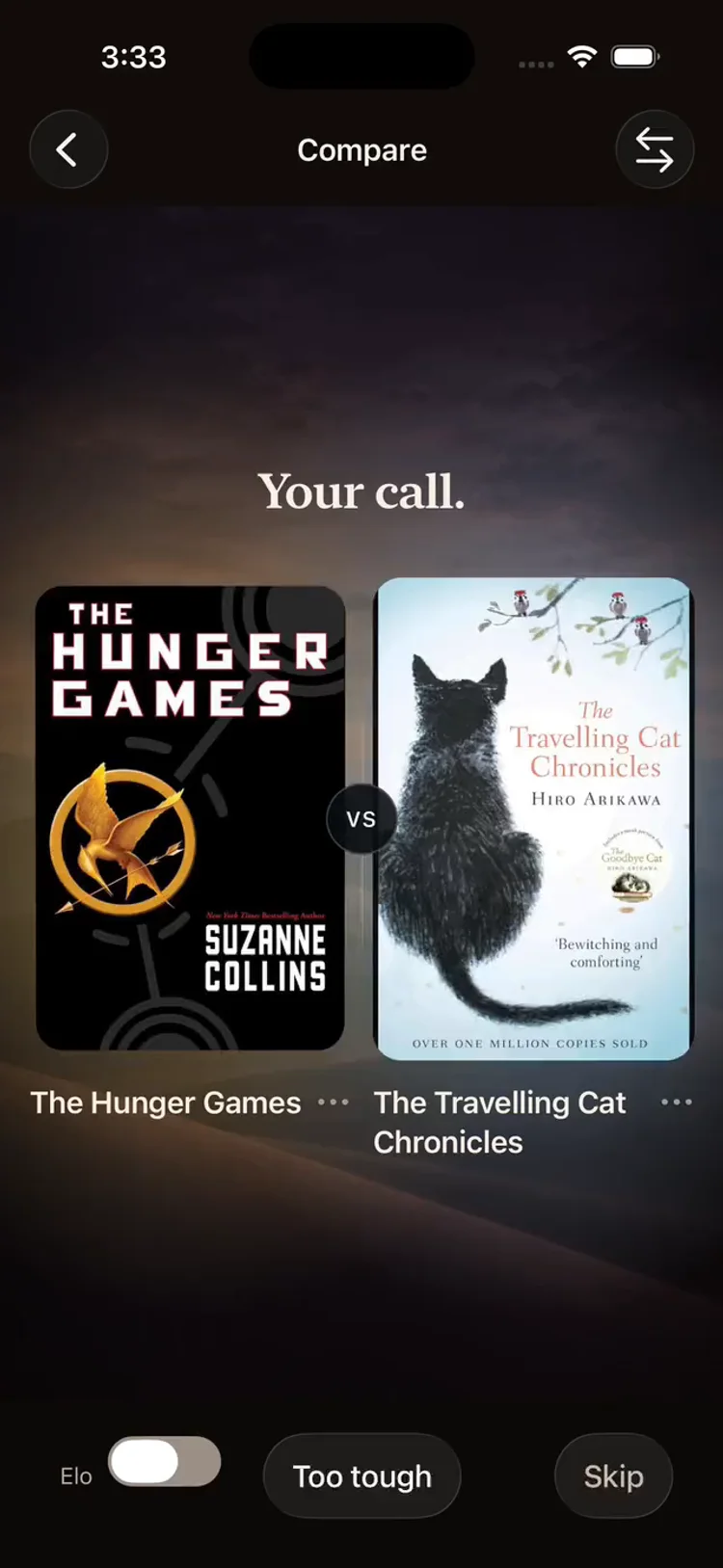
Crestora’s iPhone app ranks the books you collect through comparisons. You are shown two books under “Your call.” and choose the one you prefer. Choosing Too tough records a draw, and Skip shows another pair without changing your rankings. Each decision updates an Elo-style score for both books.
Books then fall into tiers by score. From the top, Crestora’s book tiers are SS Essential reading, S Extraordinary, A+ Outstanding, A Excellent, B Strong, C Solid, D Uneven, E Weak and F Not for me. Books you have not compared yet wait outside the tiers until they have a score.
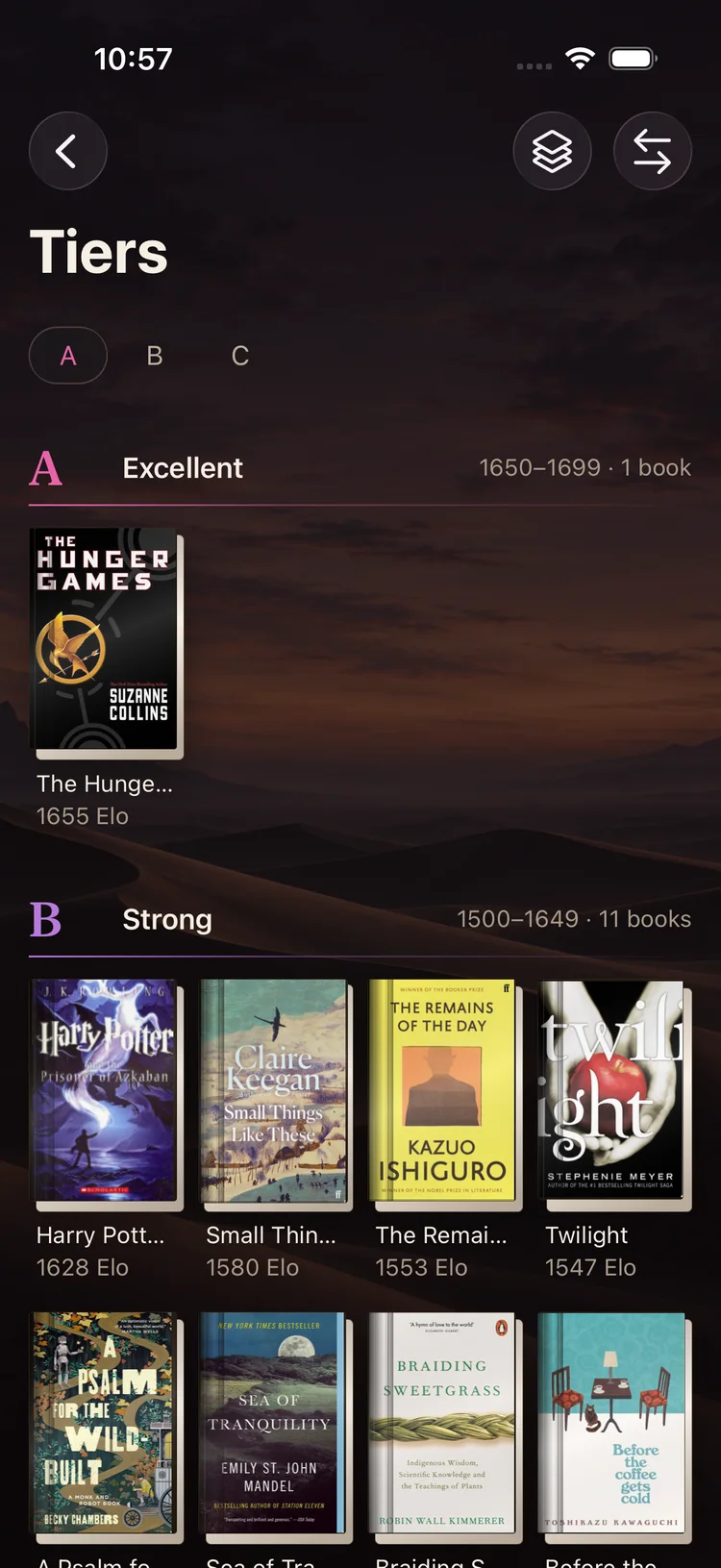
Keep your question in mind as you compare, and treat the order as something that will change as you read more. Crestora is free on iPhone.
Questions
Questions, answered.
How do I rank books from different genres?
Use one personal question that applies to every book, such as “Which has stayed with me more?”, rather than asking which is better written. A good question lets a thriller and a literary novel meet on equal terms.
Should I rank a series as one book or several?
Rank books separately if you remember them as distinct reads, and as one entry if the series feels like a single long story to you. Whichever you choose, apply it consistently.
Should books I didn’t finish be in my ranking?
Usually not, because you are comparing an incomplete experience with complete ones. Keep them in your reading log marked as unfinished instead, or place them in a clearly labelled bottom band if you want a record of what did not work.
How do I rank a book I have reread?
Rank it by how it feels after the most recent reading, and keep a note of how your response changed. Your reading log can keep the earlier impression.
Keep reading
More guides.
- Books · Guide
How to keep a reading log
Keep track of books you have read. Choose a few useful fields, borrow a worked example, and start a record you will want to revisit.Read the guide - Films · Guide
How to keep a film log
Remember the films you watch and the evenings around them. Choose a movie logger, learn what to record, and start with a free spreadsheet template.Read the guide - Films · Guide
How to rank your favourite movies
Five stars each? Work through a personal top ten with comparisons, a four-film example, and room for ties and changing taste.Read the guide